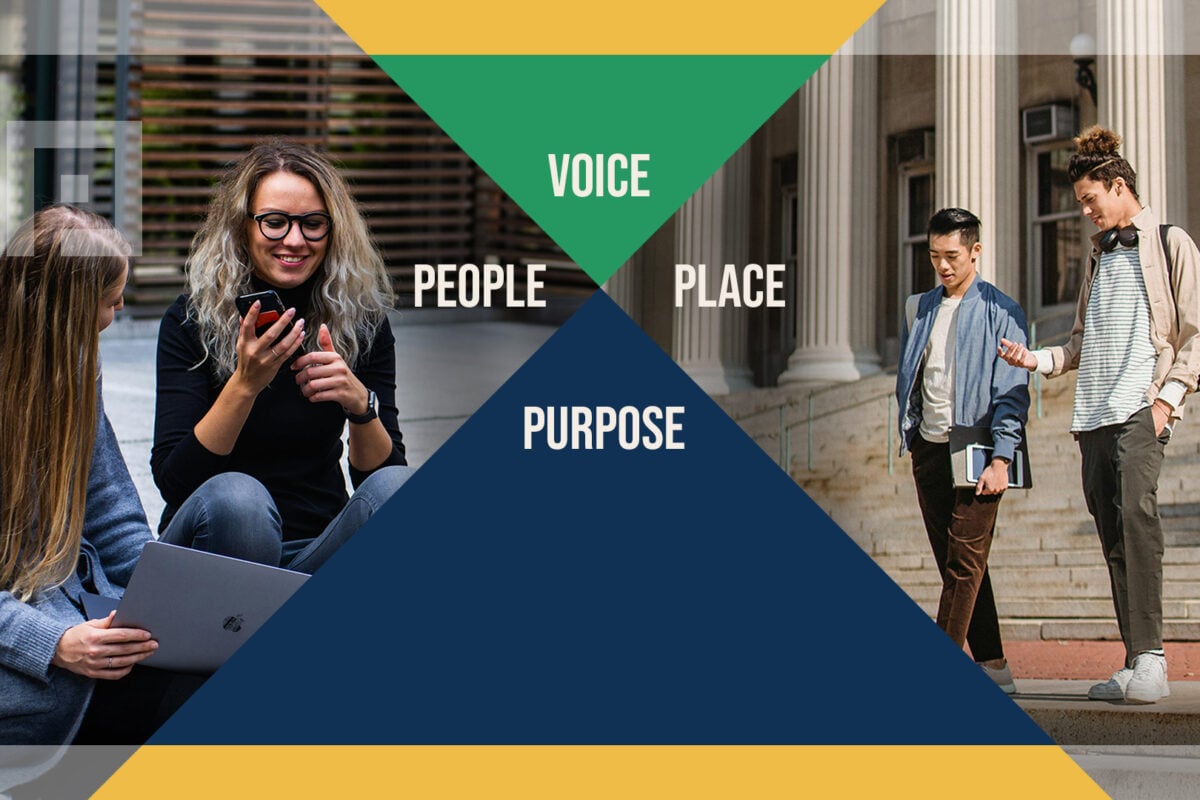
Prospective students can decide quickly whether a campus feels right for them. Frank Delaney and Lien Do of Paskill join Douglas Benedict of Academic Image to explore how authentic, emotionally grounded photography shapes that first impression, builds trust, and helps institutions stand out in a crowded enrollment landscape.
Show Notes
Gain new insight on what authenticity really means in enrollment marketing and how campuses can move beyond staged visuals to tell honest stories about place, people, and culture. From planning smarter photo shoots to understanding student visual literacy, this conversation breaks down what works now and what truly resonates with prospective students.
What you’ll learn
- Authenticity matters more than ever. Students can spot staged or misleading imagery instantly.
- Sense of place drives connection. Campus photography should feel unmistakably unique to your institution.
- Emotion builds belonging. Images that capture real moments help students see themselves on campus.
- Plan with intention. Start with enrollment and program priorities before the camera ever comes out.
- Quality over quantity. A focused set of meaningful images outperforms large libraries of generic shots.
- Respect and consent are essential. Trust and comfort lead to more genuine student engagement.
- Leave room for the unexpected. Some of the strongest images come from unplanned moments.
- Minimal editing wins. Overuse of Photoshop or AI can erode credibility with today’s visually savvy students.
- Collaboration fuels success. Enrollment teams, creatives, photographers, and students all shape the story.
Transcript
Cathy Donovan [00:00:00]:
Hello and welcome to Campus Spirit, a special series within the Innovating Enrollment Success podcast where we dive into how colleges and universities bring their campuses to life and connect with prospective students by showcasing what truly sets them apart.
Photography is often the first window into a campus. Its culture, its energy, and its sense of belonging. Authentic images can make a powerful difference in how prospective students perceive their potential fit.
I’m Cathy Donovan, agency marketing director at Paskill. Today I am joined by Frank Delaney and Lien Do of Paskill along with Douglas Benedict of Academic Image.
Frank is a creative leader with a strong foundation in photography, bringing experience across higher education and global brands, including Fila and DeWalt. He has overseen and produced large-scale photo shoots from initial concept to final delivery, using visual storytelling to support impactful brand narratives.
Douglas is a higher education-focused photographer with more than a decade of experience creating visuals for colleges, universities, and preparatory schools. Through Academic Image, he has collaborated with institutions such as NYU, Penn State, Rutgers, Temple, and Lehigh producing award-winning photography and video that captures authentic campus experiences.
Lien is an account manager at Paskill and a passionate photographer whose work explores culture and human connection. She recently traveled to Vietnam where she captured a photograph that was selected for public display by the Luzerne County Transportation Authority. She has worked with brands such as For the Culture and was recently selected by Runway Seven as a photographer for New York Fashion Week.
Welcome everyone.
Frank Delaney:
Hi.
Lien Do:
Thank you, Cathy.
Douglas Benedict:
Hey, thanks for having us.
Cathy Donovan:
Well, we have a lot of experienced photographers here today, and that is very exciting for me. So I just want to start us off with this question. What makes photography feel authentic, especially in enrollment marketing today?
Frank Delaney:
Yeah, that’s a great question.
Authenticity is such a buzzword, I would say now. It’s always kind of been, but it’s definitely thrown around very loosely. Everybody has a feeling about it. But I think what guides me creatively, at least when I’m working with Lien or Doug, authentic kind of means in the eyes of an enrollment marketer, does it have a sense of place?
Because we’re talking about locations, we’re talking about campuses, we’re talking about schools, it always needs that sense of place. Like it could feel like nowhere else but this school at this university.
And then I would say maybe a second thing, whenever we’re discussing a shoot or how to make it feel authentic is that it has to have a certain level of passion, a passion for the programs, a passion for the personalities on campus.
You know, every school has a differentiator of sorts. So, I would say like place and passion are two things that I kind of key in on creatively when we’re talking about being authentic.
Cathy Donovan:
What about you, Doug? Does Frank’s definition translate into what you’re looking for?
Douglas Benedict:
It’s absolutely what Frank said.
You know, for me it’s very much a baseline, does this look and feel real to me? You know, does this pass a basic gut check? And I think that it’s very instinctive. The younger person is the more instinctive it is to just immediately get a gut feeling for what’s the BS level on this.
It’s like, did this actually happen, or could this actually happen? And you know, I think it’s what Frank said, and I think that it implies an honesty, and you know, if we can’t begin a conversation with a candidate student with honesty, then we’re not even in the running. I think that’s why it’s so compelling right now, and I think it should be really compelling.
Cathy Donovan:
How about you, Lien? How do clients react when they see images that may be authentic or may be not so authentic?
Lien Do:
I think working with clients, they get really excited, and they’re proud when images feel generally authentic and it’s showcasing their students and their campus. I think every campus is different from its buildings and its traditions, and showing students on campus and engaged in extra curricular activities helps tell those unique stories. I think the moments feel true to the institution and reflect what the students look like. Rather than something that’s staged or pulled from stock photography.
Douglas Benedict:
And kind of to that point, the flip side of it’s true too, which is that if we’re trying to create, we’re trying to be all things to all people, and we create this illusion of something that our school isn’t, and people are drawn to it, then it’s just a waste of everyone’s time.
If we’re telling clients, be true to yourself and be honest to who you are and what makes you unique. And if they lean into that, photography’s just a part of that, but it’s it saves everyone a lot of time by knowing what you’re not and to be unique and put that out there in a straightforward way.
Cathy Donovan:
Okay, so let’s talk a little bit about getting that photography. Frank, do you want to talk about how you direct a campus to not be overly staged or when some staging is needed to reach the goals that you might have?
Frank Delaney:
Yeah, Doug made a great point about the BS meter, and Lien made a great point about our higher ed clients get excited when they see their imagery, and I think that’s a big part of it. That’s something that we try to bring up in that early conversation about you want to be honest, you want your first touchpoint to be authentic. As Doug said you don’t want to mislead them down a path because brand is a very nuanced thing.
Brand can be good and bad, and if you don’t define it properly, people fill in the blank for you. So. One thing we do is we role play a little bit. I know Lien and I have worked on a couple pitches where we help guide them to have those honest conversations, to work with a photographer early on, do a little pre-planning, find the right student that’s in the right program that they want to focus on because we try to be as honest as we can be. Now of course, there’s always movie magic and there’s always some things that we can’t control. It starts early and often, I guess I would say, when it doesn’t just happen. And I’m sure Doug can allude to that as well, like doing a little pre-planning around a specific program they want to feature.
You know, we can’t get an accounting student to act like they’re a physical therapist, so to speak. We try to guide our client to be authentic from staging, from casting, and just, you know, carry that through to the end.
Cathy Donovan:
Lien, what challenges do you hear from campuses as they try to embrace more authenticity in their visuals?
Lien Do:
I think the obvious answer is budget. We hear that budget is an issue for many things that campuses are trying to do right now, but they’re restricted to what is in the budget. Many institutions want to capture authentic moments in and outside the classroom, but the biggest challenge is that they lack the resources to do so, or that their teams are really small.
Many campuses rely on one big photo shoot a year and they expect it to last one or two years, or even longer than that. Or they lean into student workers to take photos. Although I think that’s a really great option, a lot of students don’t have the availability to take these photos because they are limited by their class schedules or other commitments.
I think one thing that campuses can do to help is maybe budget some funds for photography, even if it’s not something that they’re definitely going to do. Having that as a backup plan can help make a difference in capturing moments, more than just once a year.
Cathy Donovan:
Very true. So how about when you have a photographer lined up and it’s go time? Doug, this one’s for you. How can campuses really take advantage of shoot days to create more genuine moments with students on campus?
Douglas Benedict:
What that makes me think about is, and this sounds self-serving, but a lot of times the client is so close to their subject matter that they need people like the folks in this conversation who come from an outside perspective to help them really appreciate what differentiates them from other schools and other programs. I think that the first step in that kind of authenticity, it begins with a conversation and maybe lots of conversations and us helping them, talking to us about, the message they want to send.
My clients are so good at so many things. But a lot of times visual literacy, isn’t it. It’s a process of them conveying the message that they want told. And then for us, helping them as visual people, showing them the way to build and create that narrative visually that helps tell the story that they want to tell. That’s how it begins for sure.
Cathy Donovan:
That makes a lot of sense. There are planning and conversations, I’m sure. I think I just want to switch gears a little bit to student perception. Clearly, it’s what the clients think of themselves on their campus and what we as marketers might think, but I am curious what prospective students consider to be strong imagery or not. You know, if you’ve been in those conversations with students, what makes them think what’s a compelling image or not? I’d love to hear.
Douglas Benedict:
What I love about working with this age group is the younger generations are even more visually literate than older generations. The kids that I’m working with now are, they tend to have had a camera in their face from a very early age, and they understand imagery. Kids love to have their picture taken. People my age, not so much. They genuinely get excited about the process. They understand visuals and they really enjoy it.
They like being involved in the process. It makes them feel good. It makes them feel like they’re giving back to their school. And the students are also really invested in their school, and they just see it as their way of giving back. That’s a very positive thing that I’ve seen, you know, as far as the students go.
Cathy Donovan:
I can definitely relate. I know from my own daughters that I get a lot of feedback about what makes a good photo or not, and apparently most of what I’m taking is not so great.
Frank Delaney:
The mini creative directors at home.
Douglas Benedict:
Right, yeah.
Frank Delaney:
To kind of add on to what Doug said, a lot of these current students have grown up in this social media space where they’ve participated. They’ve interacted, they’ve liked, they’ve commented, they’ve shared, they kind of understand what’s needed, and there is a BS meter associated with that.
They know what’s real. They know what’s fake. They’re very educated in the sense of, and I love that line, Doug, visual literacy. Now, now, when you look at it from the brand side, the school, everybody’s voice can’t be part of your brand story. You have to be a little refined when it comes to what do we amplify, what do we downplay, what do we share?
So a lot of that is sort of this mosaic approach where one image can be a story. One video that’s 12 seconds could also be part of that story. I guess I could say as you’re developing content, whether you’re, a professional photographer hired to do a job, or you’re an agency that’s supporting, or even if you’re working for the school and you have an influencer on campus who’s a student, you have to give them a little guidance, some parameters of where we want to focus.
Here’s maybe not what we want to showcase, but we’ll give you access to things that are going to help guide your opportunities to shoot things and that means what you choose to put the lens on, so to speak. Perception is a two-way street where it’s not only the students, but as a marketer, you have to help them refine the focus.
And it’s not on everything, but it’s on the one thing that can sort of support the school, the brand, as Doug said, that differentiator that makes them unique. This school has its own story to tell.
Lien Do:
For me the most important element that I’m looking for is emotions. I think emotions make an image feel truthful, and as cliche as it sounds, there’s a reason people say a picture is worth a thousand words.
A lot of times those words revolve around feelings. Have you ever looked at a photo and literally felt something inside of you? And I don’t even think that the goal is to capture the emotion for the person in the photo or the person taking the photo, but also for the people viewing that photo.
You want to be able to capture something that somebody looks at and says, wow, that photo makes me feel sad or happy, or I can tell that those people are in love in this photo. When it comes to higher ed, for example, if Doug is photographing a nursing student and Frank is using it in an ad of some sort, I think the emotion needs to be shown in that photo to speak to prospective students as well.
You want them to feel like they can see themselves in that person’s shoes to feel inspired, connected, and empowered to imagine themselves becoming a nurse or being on campus or whatever path they’re considering. You want to make them feel like they belong there.
Cathy Donovan:
Absolutely. I know when I’m taking photos, the best ones I think are when people don’t realize I’m taking them and people can just be themselves. I like that kind of moment of not posing because I think it feels more genuine. Obviously, students go through so many emotions every day and only showcasing those super staged ones can feel kind of forced. Doug, curious how you might work with students to show that genuine expression. I know you’re trying to build a moment, and I know it has to link to marketing goals, but we also want it to feel true.
Douglas Benedict:
Part of the power of photography is the immediacy of it, right? You can be exposed to an image, and it’s not like reading words where you have to consume something. A reaction to an image is immediate. And Lien has pointed out the secret sauce, which is that an image has the ability for the viewer to put themselves into that situation.
When I am trying to capture an environment or capture an image, what I wanted to convey to the viewer is, hey, these people look like people that I could be with. This place looks like a place that I can imagine myself being in, right? I don’t care if they’re having a moment of extreme excitement or joy or whatever, but for me it’s more about what kind of emotion does this elicit in the viewer to the parent? Is this a place that I can see my kid going to school? Does this teacher look engaged? Is this the teacher that I want my kid to be exposed to? Is this a welcoming environment, a supportive environment, those kinds of things.
I think that combination of the viewer reaction and the immediacy that is the power of photography. I think that’s the power of it. That’s how we can use it to build these visual narratives, to create these spaces. In the minds of the people who might be interested in this school.
Cathy Donovan:
Great points. I’d like to hear from Frank about how students might be building their own channels and followers and have their own personal storytelling happening, which is very relevant too. Frank, please talk a little bit about how making sure that the student feels empowered to tell their own story, but maybe that’s not the same thing as what’s needed for a photo shoot for campus marketing materials.
Frank Delaney:
It’s actually an interesting question because as I think about it and what I’m hearing, you know, everyone say, is that most schools do their own sort of photojournalism public relations. They’re shooting a lot of content. Capturing events, capturing sports, and awards. And one thing that I do when I have a project on my plate is I go back and I look at all that content. I look at all, and this is one of those secret sauce moments, I go back and I look for heroes on campus.
I look for people that love the camera. That sounds a little heavy handed, but people that are comfortable with the camera. When we have that conversation about being authentic and featuring a part of the school, I want to find that student. Remember that photo for that baseball team award ceremony? And that student did this. I heard that they’re an accounting major. I think they’d be great for this.
Part of that storytelling is something that the school could be doing on their own that they don’t even know it. They’re capturing these influencers. They’re capturing these brand and school ambassadors and what they’re doing for me, when it’s something that’s on my project plate, I’m seeing them, I’m acknowledging that they’re out there in the world, they’re doing good stuff.
To your point, Doug, is that the biggest thing about being authentic is to put people in the limelight that they’re already comfortable being in. And what it does is it just gives them a little boost of confidence to even to our clients to say, hey, you got some nice gems here. You got some really great folks that I think are going to be really amazing when we put them together with the right photographer, with the right messaging and the right ad campaign, it’s going to be a real special moment.I think that’s kind of how that personal overlaps with sort of the more of the function of school and the promotion of the school.
Cathy Donovan:
Okay. I think that actually leads into the next question. When you’re working with a school, consent is handled through forms, so there are no surprises. Everyone’s signed off. That part is very clear, but comfort in front of the camera is a different thing altogether. Curious Lien, Doug, and Frank, how do you think about respecting people’s comfort levels while still shaping a photo shoot? How do you work with your subjects to collaborate toward that right moment? And then on the flip side are there times when you’ve just had to accept that this is what the scene’s giving me, where moments are built by building trust. Any stories come to mind? Lien, I’d love to start with you.
Lien Do:
I think for me, as you mentioned, I think consent is really, really important and making sure that they’re comfortable with you taking photos of them and also being really respectful and mindful of them.
If I’m traveling to another country, I think that is particularly important because people from different backgrounds have different beliefs and you want to be respectful of that. So for me, I always tell people exactly what I’m capturing, how I want them to pose, if they’re comfortable with it.
I want to make sure that they’re comfortable because I think once they’re comfortable and they trust you, then they’re going to be their authentic self in that photo.
Cathy Donovan:
Doug, do you have anything to add when it comes to working with your subjects and trying to make sure you’re working with them in a way that they’re most comfortable with?
Douglas Benedict:
Yeah, absolutely. I mean, there are a lot of different kinds of situations. The most common thing that I do with my schools is, and you know, it very much speaks to this authenticity thing. Maybe everybody knows this, but like back in the bad old days, what we would do is in a full day we would schedule three shoots and we would contrive every single component of those shoots.
It’s like, okay, it’s going to be a picture about this. And, we’d go through casting, we’d look to see what they’re wearing, and it’s all going to happen at two o’clock on a Tuesday. The way things work now by and large, is I move from classroom to classroom or situation to situation and move into actual classroom environments.
And the reason I bring that up is that when I walk into a space where a classroom is taking place, I tell people who I am, why I am there, what these photos will be used for. I just say, look, is there anybody here that’s just not feeling it today? And usually everybody’s cool. Sometimes I’ll get a raised hand and I’ll just say, that’s totally fine.
You know, don’t move. I’ll just, you know, not include you, but it’s like a lot of it is just asking that permission, being upfront about who you are, what you’re doing, why you’re doing it, and then asking for that permission and just respecting that privacy. It is just key and then you move on.
So that has worked really well for me, and I think it’s gotten a good response.
Cathy Donovan:
Well, I’ve seen that in action and I know that it worked very well. So a little bit of logistics here for the gang. We’re going to talk first with Frank. What’s that one actionable step campuses can take before a photo shoot to set themselves up for a great shoot and hopefully some authentic moments? I know it’s a lot of planning that goes in beforehand.
Frank Delaney:
This is my favorite question. All the invisible things. There’s definitely trying to do some pre-meetings and level setting and all the buzzwords we’re trying to ladder up to their direction for the campaign and. Doug alluded to it, Lien alluded to it, you can’t do everything with the time you have.
One of those things, and we call it like a pre-production book or we call it a one-sheeter that just gets everybody on the same page. And sometimes it’s easier to make it simple. And it’s really just a matter of who are we trying to shoot? Where are we trying to be? As Doug said, we’re going from classroom to classroom.
Let’s identify those places because we’re not only creating content, we’re creating a plan to actually do it physically. We have to walk and move and we have to interact in the space. So we kind of try to level set as far as who we’re shooting, where are we going to be, here’s a little bit of direction, it’d be great if you didn’t have our competitors color on, you know, so we might say a few things like that, which is important.
When you talk to big schools, especially in Maryland, you can’t wear anything red unless people are going to think you’re a terrapin. I’m sure the same is true in any other state school, but that’s one thing. I think it’s really important. And I know Lien works hard to align our clients to say, you know, let’s put some things on paper.
And let’s try to use that as a guide. It’s not going to be the recipe, but it’s going to help us guide the day of the shoot. So that’s always a helpful thing.
Cathy Donovan:
Well, I’ve been part of that process too, and I’m always amazed by the level of detail that goes into the pre-planning. When a shoot feels seamless, you can really see how worthwhile that time was. So, Doug, what’s the one thing teams can do during the shoot to help those moments unfold naturally?
Douglas Benedict:
Frank is right. It’s plan, plan, plan, and then plan some more. But the gift of the gods, as far as I’m concerned, is serendipity. And it’s when you’re doing this very planned shoot, and that’s all absolutely necessary to keep your eye open for things you had not anticipated, because that always seems to be the thing that you walk away with that’s most compelling.
And it can be a small thing, right? It can be on our way from shoot one to shoot two in the hallway. We passed this student that had this great look. She dressed in a way that I could have never have had her get dressed. I never would’ve thought of this. Or it can be a person, it can be a location.
It’s the serendipity component that is always what you got to watch out for. And it’s really the bonus material. So I think it, yeah, you’re executing all the line items you had planned on executing that day, but it’s also, while you’re doing that, keep your eye open for the things that happened that are way better than you could have ever planned.
Cathy Donovan:
Okay, great. And that can just make the shoot day more fun too, when you’re just a little bit more open to those unexpected moments. Alright, Lien, now you’re up. All this content is coming to you and your clients. Just curious what your recommendations are to ensure that these images are the truest they could be.
Lien Do:
I think it’s really important, in today’s day and age, to limit how much you’re editing a photo, whether it’s with Photoshop or AI. I think Doug said it best earlier, students grew up around a camera and they know when a photo is botched and they know what is real and what is not real.
I definitely think there’s a time and place for AI, but I don’t think it belongs on campus when you’re trying to capture authentic campus photos and campus life. For one, like I mentioned, students will know right away if something is fake. I see it all the time, even if I’m scrolling through TikTok. I can tell when something is generated by AI and I think that just breaks trust.
And secondly, I think you mentioned it earlier, Cathy, that there’s a lot of serious privacy and consent considerations that need to be taken into consideration when using students’ likeliness. I think those regulations need to be reviewed carefully by institutions, if they want to use their students’ likeliness in advertising. So keeping editing to a minimal, keeps the image true and also just avoids any unnecessary risk.
Cathy Donovan:
Alright, final question for all of you. If enrollment marketers could change one thing about how they approach campus photography, what should it be? Frank?
Frank Delaney:
That’s a heavy question. Two things I would say bring in a partner like us and, don’t be afraid to nurture your on-campus talent as far as influencers and TikToks and anyone making content, because they all want to contribute, they all want to make things. I think the guidance you could bring as sort of being the marketing team would be give them access to certain areas, but then also help guide them to say, you know, here’s what we really want to focus on.
So I think that’s a twofold thing. You know, we’re leaning into your professionals as well as nurture your on-campus talent that are really willing and able to do it.
Cathy Donovan:
Makes sense. Lien, how about you? What’s that parting advice for enrollment marketers to do photography better moving forward?
Lien Do:
I think they should work backwards. Determine what the priorities are, what you’re trying to capture and why you’re trying to capture it before you actually go out and capture it. That’s something that I’ve learned working with Frank and working with our clients a lot of times. We’ll receive photography or photos and they won’t work with what we’re trying to do.
Institutions might be trying to capture and promote their nursing program, but they don’t have any nursing photos to use. So I think working backwards is something that will be helpful for not only the clients, but also the people that are trying to promote the programs and ads.
Cathy Donovan:
That makes sense. How about you, Doug? Some parting advice for enrollment marketers and photography moving forward?
Douglas Benedict:
Yeah, this is going to echo both Lien and Frank a little bit in that I’m frequently brought in when a client has identified a problem and then solved the problem on their own, and then I’ve been brought in to execute that solution.
I want to be brought in at the problem because there’s a really good chance that the problem they’re experiencing is something that I’ve worked with before. I have experience with and have either failed with or succeeded at, and I just want to be involved in the conversation at an earlier point.
Cathy Donovan:
It’s hard to make those accommodations day of shoot when you’re just implementing their directive. That all makes sense, I think in a world of there’s the need for no BS images and the budgets are short and there’s all these goals. So it sounds like communication is number one when it comes to getting better quality images moving forward for sure.
Well, I just want to thank the three of you for joining me today and sharing all of your insights. I know I’m definitely inspired to look for better images on campus. So as today’s conversation shows that authentic photography is not just about taking a picture. It’s capturing truth, culture, emotion, and belonging, qualities that matter deeply to students searching for their right fit.
For more about today’s guests, see our show notes or connect with them on LinkedIn. If your institution is looking to bring more authenticity to your visual storytelling, Paskill is here to help, along with our good friend at Academic Image. So thank you so much for joining me today.
Douglas Benedict:
Thank you, Cathy, for having me.
Frank Delaney:
Thanks, Cathy.
Lien Do:
Thank you, Cathy.